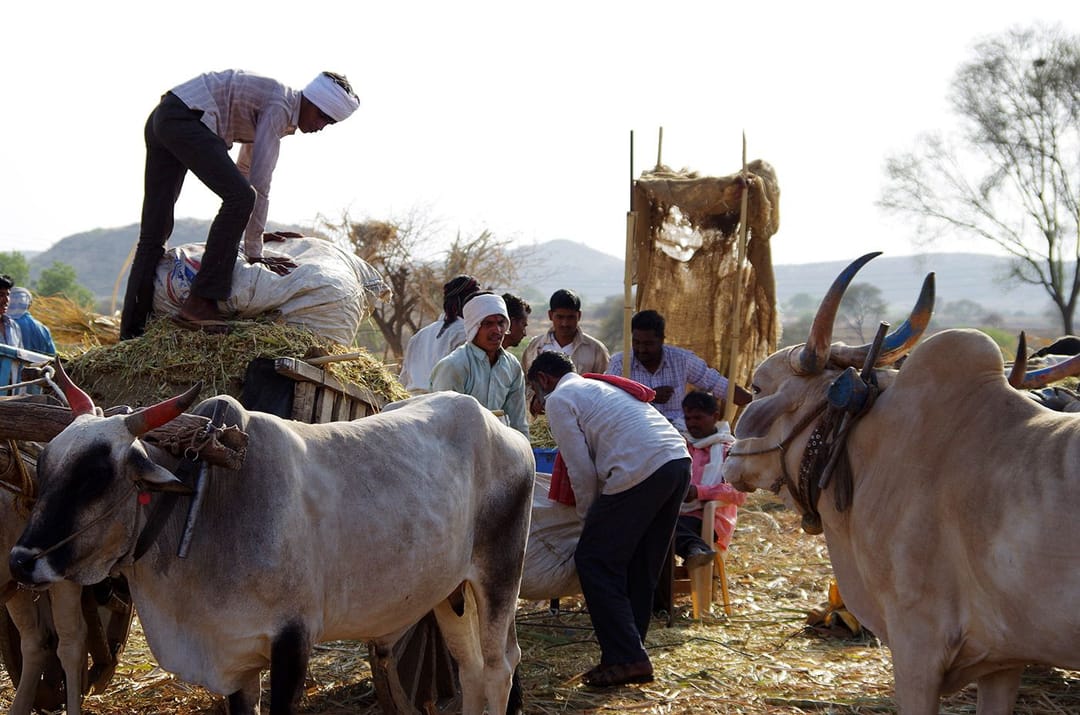
But what this 100-acre tract of land, about a kilometre from Palvan village in drought-stricken Marathwada, has in abundance is grit.
It’s reflected in the words of Vishnu Baglane, 28, one of the hundreds who have moved in with their cattle from villages far and near, drawn by the free sheds, water and fodder for their animals, and free lunches for themselves. All provided by a non-governmental organisation, with state government help, at a time when successive droughts have left the earth parched and the fields barren.
“I tell myself several times a day not to give up,” Vishnu says, splashing a mug of water on one of his 20 animals in temperatures approaching 45 degrees. “It’s just a matter of hanging on for a few more months.”
He is hoping this monsoon will be good.
Vishnu and his father, Raghunath Baglane, 64, have been here since September, after the fourth straight failed monsoon in Marathwada. The son tends to the cattle from 7 a.m. to 7 p.m.; the father arrives after dinner to sleep in the cowshed through the night.
The women of the family often come visiting from their home in Kakadhire, five kilometres away, bringing the children who prance about the place. Sometimes, close relatives drop by, too.
A long history of chara chhaonis
Cattle camps or chara chhaonis have had a long history in Maharashtra and Karnataka as a short-term drought measure, apparently starting from Shivaji's reign in the 17th century. Since 2011, they have become a part of the summer landscape in Maharashtra, particularly in its dry central and western belts.
But last year was the first time that some of them stretched till winter and on to the new year, and were still continuing through this summer.
Social organisations or sugar factories lease farmland denuded by drought and set up these camps, running them with help from the state government or goodwill-seeking political parties.
Some 350 cattle camps sheltering nearly 250,000 animals were operating in Marathwada's three worst-hit districts: Latur, Osmanabad and Beed. Of these, Beed accounts for 265 camps, small and big, Osmanabad had 80-odd and Latur just one.
The camp at Palvan, 15 kilometres from Beed town, harbours about 5,000 small and big animals, belonging to around 300 farmers from 32 villages.